
Introduction
eCommerce, as we know it, is changing…
With AI entering the space, it’s evident that by 2026, simple search will be replaced by intelligent automations and rising customer expectations. With AI, eCommerce is expected to boost by $3.66 trillion in 2026.
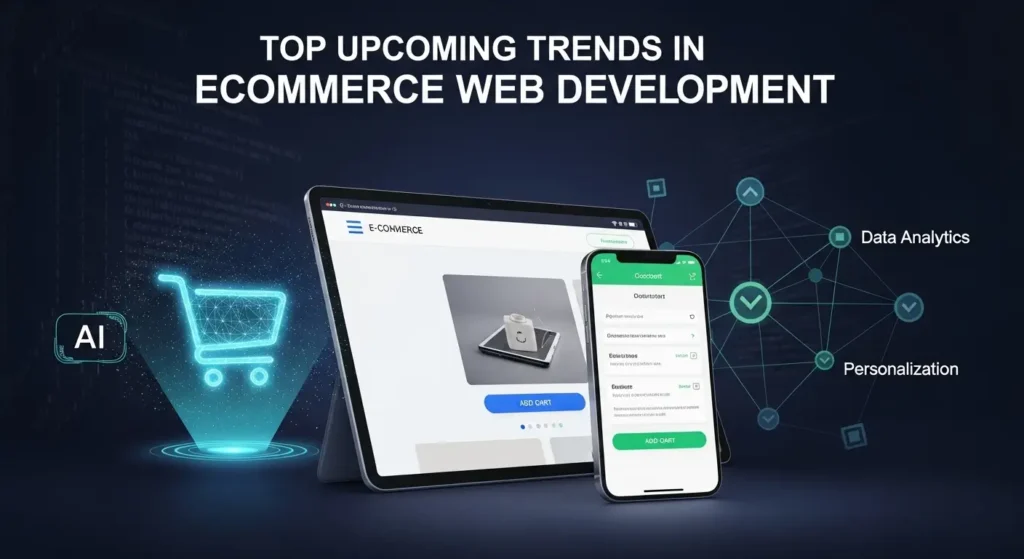
This blog takes a closer look at the upcoming trends that will shape eCommerce web development for 2026 and beyond.
Continue reading to learn more about how things could change for your business and how collaborating with a professional eCommerce development company can help you gain an edge.
Let’s get started.
5 Upcoming Trends in eCommerce Web Development for 2026
Composable: Without the Chaos
Headless is growing up. The winning pattern isn’t “split everything”; it’s composable where it pays, with clear API contracts and a thin orchestration layer. Product truth flows from PIM/ERP; pricing, search, and checkout travel through a gateway; the storefront renders with SSR/ISR, so content is fast and indexable.
Teams standardize event names and design tokens once, then reuse them across brands and regions. You can start by freezing the integration contract (OpenAPI), adding a gateway, and then measuring page-level p95 latency before/after.
Edge-first Performance & Intelligence
CDNs are becoming application platforms. In 2026, more logic moves to the edge: geo-aware pricing, A/B routing, cache mutations, and even lightweight recommendation models. The result is faster first paint and fewer round-trip.
For privacy and latency, expect selective on-device inference (e.g., ranking a short list client-side) paired with server grounding for accuracy. Start by pushing personalization hints and redirects to edge functions; log wins in seconds shaved, not anecdotes.
Making such changes to your store alone can be challenging. If you need a seasoned partner to turn plans into production, software development company Brainvire can help you ship fast without breaking things.
Search Grows Semantic
Shoppers type questions, not keywords. Vector search and hybrid retrieval (BM25 + embeddings) make “waterproof hiking boots under $60” feel natural. Merchandisers still set rules (boost margin, protect inventory), but semantic understanding handles synonyms, misspellings, and intent.
Expect explainability in the UI (“Showing waterproof because you asked for rain hikes”) to build trust. Start by piloting semantic search on a single category; compare click-through, add-to-cart, and zero-result rate.
Wallet-first Checkout with Passkeys
By 2026, “create a password” during checkout will feel antique. Passkeys and wallet-first flows (Apple Pay, Google Pay, UPI, PayPal) reduce friction and fraud in one move.
A payment orchestration layer chooses providers by risk, cost, and uptime. Additionally, features like address autocomplete, duty/tax estimates, and one-screen order review help keep abandonment low, especially on mobile.
Privacy-led Personalization
Signal loss is real; so is consumer fatigue. The durable approach is zero-party preference centers, clean first-party events, and server-side tagging. Micro-personalization uses declared needs (“commuter, size 8”) and session behavior, not shadow profiles.
Email and push sequences become shorter and more useful because you actually know what someone asked for. Start by building a two-question preference capture on first purchase; use it to drive one tangible on-site change.
Smart Changes You Could Make to Your eCommerce Brand Today!
#1 B2B UX catches up to D2C
B2B buyers expect the same polish: fast search, transparent pricing, and instant re-order. The difference lies in the complexity under the hood, including account hierarchies, negotiated price lists, quotes, PO flows, credit checks, and approvals. The best stacks expose this through clear UI, self-serve portals, and deep ERP integration, not spreadsheets and emails.
Your Next Move:
Ship a “reorder last 90 days” experience; it’s the fastest path to repeat revenue.
#2 Accessibility becomes a brand promise
Accessibility won’t be a checklist; it will be table stakes. Tokenized color systems, keyboard-first flows, visible focus states, captions, and alt text helpers become defaults. Teams run automated scans in CI and keep a quarterly manual audit. The win is bigger than compliance: accessible sites convert better for everyone (clearer contrast, larger targets, steadier layout).
Your Next Move:
Set a color-contrast token policy and test your top three flows with only a keyboard.
#3 Shoppable video, AR, and 3D where it counts
Short video with tap-to-buy and WebAR try-ons will move from novelty to utility in specific categories: beauty, eyewear, furniture, and footwear.
The trick is restraint: small, compressed clips; 3D only where fit/scale matter; fallback images for low bandwidth. Expect WebGL/WebGPU viewers that respect Core Web Vitals instead of crushing them.
Your Next Move:
Pilot one 20–30 second product video and one 3D viewer on a high-return SKU; measure return-rate change.
#4 Returns, repairs, and circular flows
The cheapest return is the one you prevent. Pre-purchase fit guides, clear “what’s in the box,” and post-purchase nudges cut regret. When returns happen, self-serve portals, exchanges over refunds, and repair/second-sale options protect margin and reduce waste. Back-end events (RMA received, refurb complete) feed the storefront in real time.
Your Next Move:
Add an exchange-first option with instant credit; track margin saved per 100 orders.
The Future of eCommerce Development: Outcomes Over Architecture
Every trend above points to the same idea: build the minimum stack that delivers speed, trust, and clarity, then measure relentlessly.
For some brands, that’s a tuned theme plus smarter data; for others, it’s a composable stack with edge logic and semantic search. The right ecommerce web development company will cut scope, not add it, and prove value in small, shippable slices.
Why Brainvire for Your eCommerce Growth?
As a seasoned software development company, Brainvire, we pair pragmatic architecture with battle-tested delivery: API contracts first, edge-aware performance, wallet-ready checkout, accessible design systems, and measurable experiments.
Bring us one flow (search, PDP, or checkout), and we’ll ship the smallest change that moves a real metric, then scale it with discipline.
Want your 2026 roadmap to land early? Let’s map these trends to your stack and launch a pilot you can measure in weeks, not quarters.
If you want to grow your online business then contact Pedrovazpaulo for their IT consulting services.