

When sourcing medical welds, precision, biocompatibility, and reliability are crucial, as they can immediately affect patient safety. In certain situations, traditional welding can address these requirements. However, it is subject to challenges that slow production, escalate costs, or compromise quality.
Laser welding can easily resolve most of these issues. It provides a suitable option when manufacturers must adhere to stringent medical demands without compromising efficiency. Here is how it can solve these challenges.
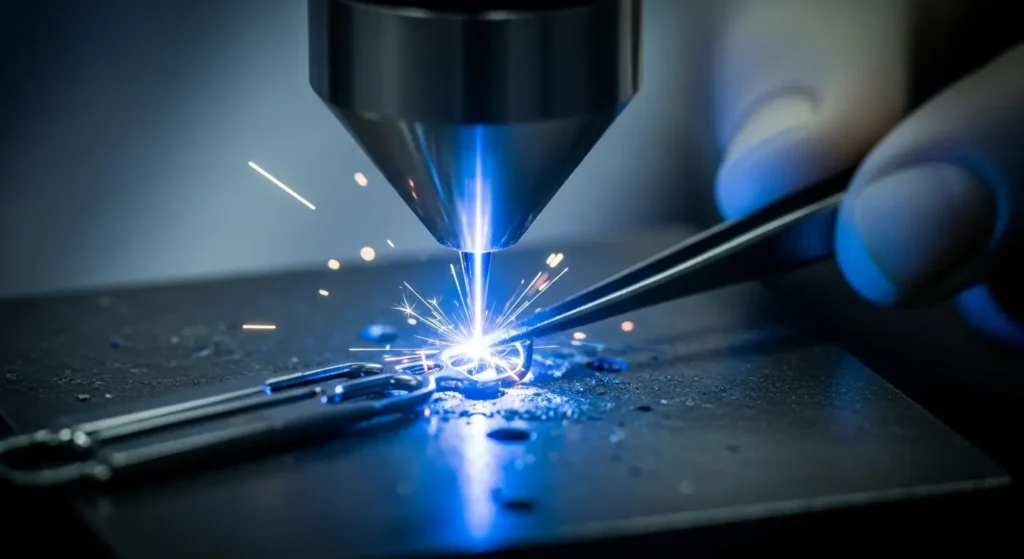
Extreme precision on small parts
Medical equipment is getting smaller. When dealing with a pacemaker case, surgical instrument tip, or catheter constituent, dimensions are frequently quoted in millimeters, and tolerances in microns. Such small parts may present challenges in traditional welding procedures, such as TIG or resistance welding, due to the fact that a slight variation in heat or filler leads to distortions.
Medical laser welding involves an intense, pinpoint-controlled beam. The level of heat input is thus very localized in such a way that other areas are not affected. This enables welders to produce the thinnest, uniform seams that are tolerant to matching dimensions without deforming.
In the case of components such as stents or micro-valves, such accuracy can mean the difference between a compliant inspection and a rejection of the batch.
Biocompatibility challenge
Metals such as titanium and cobalt-chromium, used in medical manufacturing, are sensitive. They need to sustain their surface integrity to be biocompatible. More conventional welding techniques may contaminate or oxidize the welded parts. This necessitates additional cleaning procedures. Even worse, these aspects can potentially modify the surface characteristics of the metal.
Laser welding can be conducted frequently in an inert gas like argon or nitrogen atmosphere. Additionally, it does not necessarily need filler metal to make various welds. That reduces the risk of contamination. The weld process creates clean, smooth welds that do not require much finishing mechanically.
Minimizing the heat-affected zone (HAZ)
When there is too much heat, it expands into the nearby material and softens it up, which may impact other features. In the case of thin-walled tubing, micro-electronics housings, or instruments with sharp edges, a HAZ that is too large can destroy an entire item.
Laser welding focuses energy on the area where it is needed, and the HAZ is very thin. The less thermal spread secures sensitive geometries and prevents micro-cracking or warping. It is particularly significant in assemblies where the pre-machining features or covers cannot withstand heat damage.
Cleanroom and sterility requirements
In a medical setting, welding commonly occurs in cleanroom environments where dust, spatter, and residue in the surrounding air must be minimal. Conventional arc operations produce spatter, fumes, and sparks. They increase the risk of contamination and cleaning demands.
Medical laser welding is non-contact. So:
- No electrode contacts the workpiece
- No physical arc spatter
- Minimal fume generation.
The sterility of the weld area limits the chances of any contamination and eases the process of observing ISO Class cleanroom regulations.
Welding dissimilar metals
There are medical applications that involve the fusion of metals with significantly dissimilar melting temperatures or thermal conductivity. Traditional welding methods tend to burn one material and leave the other not well fused with the first. Thus, the joint becomes too strong or distorted.
Since laser welding can be precisely controlled in terms of energy input, as well as pulsed, dissimilar metals can be joined with minimal thermal imbalance. This increases design versatility, such as joining titanium housing to stainless steel shaft in a manner that does not negatively affect either material.
Explore our investing category for insightful information.
Traceability and regulatory compliance
Welding of all medical devices should adhere to high standards such as ISO 13485, FDA 21 CFR Part 820, or IEC 60601. Conventional welding may satisfy these needs. However, providing a high degree of process control, consistency, and documentation may be an uphill struggle.
The modern laser welding systems can monitor and log parameters like beam power, travel speed, and the shielding gas flow with each weld. This electronic traceability enables:
- Quicker audits
- Reduced compliance setbacks
- Evidence that every joint complies with recorded specifications.
Post-processing time and cost
When welds contain excess material volume or surface irregularities, grinding, polishing, and cleaning welds introduce time and cost to the production process. Such finishing processes can be a bottleneck in high-volume production.
With a reliable partner like Micro Weld, you can get laser welds that are smooth and uniform and do not require secondary finishing. The outcome is:
- Accelerated throughput
- Reduced workforce cost
- Reduced chances of adding defects post-welding.
Source: Pedro Vaz Paulo
The bottom line
Although laser welding technology and associated tools mean a larger front-loaded investment requirement, laser welding makes up the difference in terms of:
- Better precision, resulting in fewer scraps.
- Less work time due to minimal post-processing.
- Increased throughput owing to compatibility with automation.
- Increased adherence to the in-built process tracking.
- Improved product quality due to a reduction in HAZ and uniform quality.
In the long term, these benefits will be reflected in reduced overall production expenses and reduced warranty claims. You also get an improved reputation for quality in the medical device trade.